Monday, April 16, 2012

‘Rawshock’ by Toby Fitch — Book launch
| by Southerly |
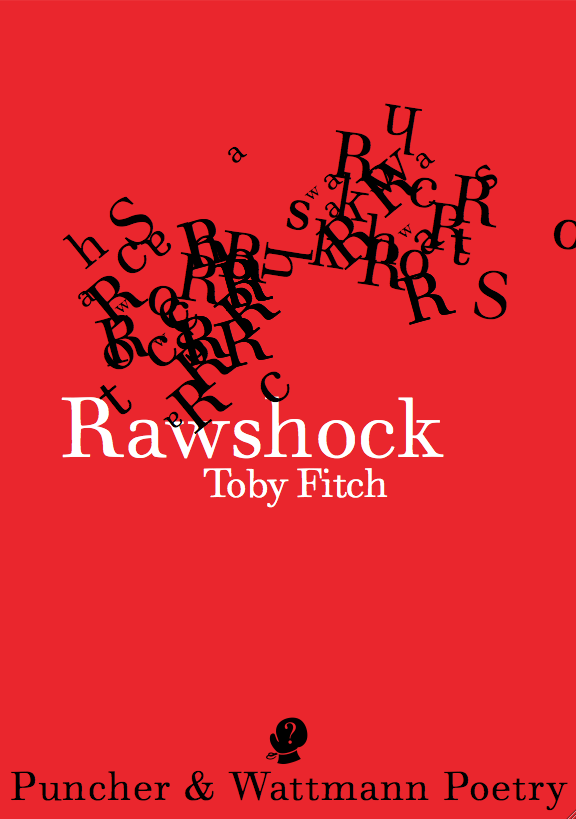
Please join us for the launch of Rawshock, by our poetry reviews editor Toby Fitch,
When: Sunday April 22 from 2pm
Where: Brett Whiteley Studio, 2 Raper St, Surry Hills
Where: Brett Whiteley Studio, 2 Raper St, Surry Hills
Using the Rorschach inkblots as metaphors, conjuring the wondrous and the monstrous in his poems, Toby Fitch brings a unique vision to Australian poetry. Old modes of expression—such as the mythic, the romantic, the symbolic and the surreal—are revived and reshaped in poems that mythologise love, anxiety, the self and city living, dovetailing inner and outer worlds with a healthy antipodean dose of absinthe and pattern poetry.
Category: Entertainment
To launch the high quality TV channel TNT in Belgium we placed a big red push button on an average Flemish square of an average Flemish town. A sign with the text "Push to add drama" invited people to use the button. And then we waited... Discover here what happened or visit http://www.tnt-tv.be for more info.
TNT. We know drama.
TNT. We know drama.
Sunday, April 15, 2012

[After a small intro about chapbooks in general, the Red-Handed blog goes on to say] One of the chapbooks in this small stash is called Shikibu Shuffle, by Andrew Burke and Phil Hall. Burke has published many books, including nine collections of poetry, while Hall is the 2011 winner of the Governor General's Award for Poetry.
Shikibu Shuffle is poetry stripped down. Stripped bare. And while there's plenty of physicality and music here, the sustaining effect comes from the total, from the whole body, and individual poems feel more like single notes -- played into the open air. And then grey, smoke-infused ones at that
nothing I see or thinkand later
means anything to me
sun holds motes floatThe playground here (and there is some sense of that, of soft-pedaled playing) is the kind you walk over in the rain. And this kind of resigned humour, where
God must be a boogie manwould probably go best, I think, with coffee and piling clouds and the feeling of having escaped something.
* * * * *
Shikibu Shuffle and other stunningly original chapbooks are now available from above/ground press or the poets themselves.
Saturday, April 14, 2012
Don Marquis and Archy's "a spider and a fly"

For those who don’t know Archy, he was the cockroach poet who used the typewriter of his "boss," Don Marquis, a columnist for the New York Sun from 1916 into the 1930s, in order to type out his poems, which then became the fodder for Marquis’s highly popular Sun Dial column. Together with his sidekick, the cat Mehitabel (she claimed to have been Cleopartra in a previous life), Archy discoursed on all manner of subjects, using only lower-case letters and no punctuation (because of his difficulty in operating the shift key). In our new Pocket Poets edition, The Best of Archy and Mehitabel, we reproduce E. B. White's introduction to a 1950 volume collecting Marquis's Archy columns, in which he writes, "The creation of Archy, whose communications were in free verse, was part inspiration, part desperation. It enabled Marquis to use short (sometimes very very short) lines, which fill space rapidly, and at the same time it allowed his spirit to soar while viewing things from the under side, insect fashion....Vers libre was in vogue....It was the time of 'swat the fly,' dancing the shimmy, and speakeasies. Marquis imbibed freely of this carnival air, and it all turned up, somehow, in Archy’s report. Thanks to Archy, Marquis was able to write rapidly and almost (but not quite) carelessly. In the very act of spoofing free verse, he was enjoying some of its obvious advantages."
| a spider and a fly i heard a spider and a fly arguing wait said the fly do not eat me i serve a great purpose in the world you will have to show me said the spider i scurry around gutters and sewers and garbage cans said the fly and gather up the germs of typhoid influenza and pneumonia on my feet and wings then i carry these germs into the households of men and give them diseases all the people who have lived the right sort of life recover from the diseases and the old soaks who have weakened their systems with liquor and iniquity succumb it is my mission to help rid the world of these wicked persons i am a vessel of righteousness scattering seeds of justice and serving the noblest uses it is true said the spider that you are more useful in a plodding material sort of way than i am but i do not serve the utilitarian deities i serve the gods of beauty look at the gossamer webs i weave they float in the sun like filaments of song if you get what i mean i do not work at anything i play all the time i am busy with the stuff of enchantment and the materials of fairyland my works transcend utility i am the artist a creator and a demi god it is ridiculous to suppose that i should be denied the food i need in order to continue to create beauty i tell you plainly mister fly it is all damned nonsense for that food to rear up on its hind legs and say it should not be eaten you have convinced me said the fly say no more and shutting all his eyes he prepared himself for dinner and yet he said i could have made out a case for myself too if i had had a better line of talk of course you could said the spider clutching a sirloin from him but the end would have been just the same if neither of us had spoken at all boss i am afraid that what the spider said is true and it gives me to think furiously upon the futility of literature |
Friday, April 13, 2012
ABC Jazz: "Happy Birthday, Billie Holiday"

Holiday's first recording with Benny Goodman will be broadcast, through to some of her final sessions. There's some wonderful Johnny Hodges with Duke Ellington from the classic 1966 Far East Suite.
Plus: new singing star Gregory Porter and his second release, Ahmad Jamal's new recording and something from one of the winners at the recent Art Music Awards, bassist Nick Haywood.
See the full playlist here.
Broadcast on ABC Jazz
Apr 14, 2012. 5:05pm - 7:00pm
Apr 17, 2012. 2:00pm - 4:00pm
Apr 17, 2012. 9:00pm - 11:00pm
More episodes of Jazztrack
Click here to enter the Jazztrack ticket giveaway to Chris Potter's performance at the 2012 Melbourne International Jazz Festival.
In and from Jacket2 - 51 Australian Poets

Louis Armand 'Mertz is Dead'
Thursday, April 12, 2012
The Prose-Poem Project

| Which of us, in his ambitious moments, has not dreamed of the miracle of a poetic prose, musical, without rhyme and without rhythm, supple enough and rugged enough to adapt itself to the lyrical impulses of the soul, the undulations of the psyche, the prickings of consciousness?”
Charles Baudelaire (Little Poems in Prose, 1869)

Volume 2, Issue 4
Read it now online at
|
Tuesday, April 10, 2012
Poetry and Tribalism - Posted by Jon Stone at FuseLit
A very interesting article which can very well echo our Australian situation ... Here is the start of it all:
'Tribalism' is, of course, a negative term, a word we use to criticise. We scorn it, want to be done with it, and yet it seems to perfectly describe a kind of attitude that few human beings avoid entirely. We identify ourselves as being part of a certain group, and round others up, usually without their permission, into contrasting groups which we define ourselves against. It afflicts British poetry culture, at least to an extent I see played out in various public and private interactions, and it could do, I think, with some objective analysis, as well as further discussion.
The three main tribes I'm referring to are: the mainstream, the spoken word scene (alternatively, performance poetry, slam or stand-up poetry) and the avant-garde (alternatively, non-mainstream or innovative poetry). Some of these terms are hotly debated, rejected or modified for clarity, but in order to get on with an article like this, I simply have to use them loosely. Via Facebook, internet forums, articles and pub conversations, I've experienced various discussions of the differences or lack thereof between the three, but these discussions tend to take place between like-minded people. I rarely see a proponent of the avant-garde square off against a regular from London's spoken word scene, for example. If parts of this post therefore seem to labour a screamingly obvious point, it's because I am addressing myself to myriad different viewpoints which, to my mind, seldom agree on what is and is not obvious.
So I'm going to try to pull some threads together. First of all, let's consider some positive (and crude) generalisations, just to get our bearings:
- The spoken word scene is grass roots poetry, increasingly popular and well-attended, priding itself on being inclusive, non-elitist and politically engaged. Spoken-word artists eschew obscurity to address topics directly and passionately through stage performance and are active in overturning the popular image of poetry as fusty and self-obsessed. The scene has its roots in the centuries-old traditions of tavern performance and oral storytelling.
- Avant-garde poetry emphasises radical thinking, playfulness and the critical importance of language. Its principle belief is that powerful institutions and the outdated ideals that sustain them can only be challenged by revolutionising and reenergising language itself, by undermining and overturning the registers and modes of exchange that reinforce current orthodoxies. It embraces feminism and minority poetics and seeks to dispel myths about poetry that limit its scope and reach, including the idea that poems should be understood merely as self-expression or versified narratives.
- 'Mainstream' poetry is not so much a scene or movement as it is a catch-all term for the most widely acclaimed poets of all stripes, as well as the numerous others whose work bears a familial resemblance to these 'leaders in the field'. Its style is defined only by whatever is popular and enduring, and shifts over time. If there is a modus operandi at all, it is one of inclusivity through emphasis on the individual poetic 'voice', rather than any particular style or school of thought. Good mainstream poetry avoids both elitism and populism, attempting to meet readers half way, the idea being that good poetry needs to be challenging but also that poets must make every effort to engage their audience.
Now let's look at the harsher negative stereotypes of each which are sometimes bandied about:
- Spoken word is the domain of aspiring comedians, hip-hop artists and rabble-rousers who like a more pliant audience, shoehorning jokes and tirades into the loosest of verse structures. It's the medium of choice for those who make little effort to refine their poetic craft and lack the patience for poetry's more subtle effects, making much of the output derivative and rambling.
- Avant-garde poetry, despite its pretensions, is dominated by middle class white academics who have failed to break into the mainstream and now disingenuously associate incomprehensibility and opaqueness in poetry with daring and cleverness. The literary equivalent of Brit Art, it's Emperor's New Clothes syndrome writ large; endless pontificating on random assemblages of text using plenty of jargon in order to prove you're part of the club.
- Mainstream poetry is a small enclave of largely white, upper middle class men who live comfortably enough to obsess mostly over trivial things and ignore most politics, look down on popular culture and compete for status in a classical canon, taking care to avoid offending too many sensibilities or challenging too many orthodoxies. Because of their (unearned) power and prestige, they are in a position to pick and choose the next generation of 'mainstream' poets from those whose beliefs and writing styles flatter their own, and, of course, from the creative writing courses they run.
There is at least a kernel of truth in all of these descriptions. There's also much in the latter three that is informed by snobbery in its various forms, and by the problem of accessibility/simplicity versus difficulty/obscurity in art, which seems to result in deeply entrenched positions. I'd like to think most people agree that both difficult and accessible writing can be democratic and a force for good, and that each can respectively feel pointlessly obtuse or artless if handled poorly. The debate that rages seems to be about where we can draw the lines, although the most heated remarks are often so hopelessly broad-brush that the debate never really gets going.

Continue to read HERE.
Submissions to VERANDAH 27 now open


Submission Guidelines and Deadlines
Verandah looks for and likes well-polished and previously unpublished works. Please refer to our Purchase page for back issues or our Samples page for the calibre of writing and art which Verandah Editors ask for. We're a student run publication, so we're unable to give feedback and are unable to return submissions. Please, please don't send us your only copy!
First submission must be accompanied by a $10 fee. For two or three submissions, the fee is $15. Submissions by current Deakin students are free (please provide your current student ID number when submitting). Please note that we will only accept a maximum of three submissions from each artist.
Each year Verandah offers a number of prizes, provided by our sponsors, for the best submissions. All successful contributors will receive a copy of Verandah 27 as token payment.
Submissions are open from February 1st, 2012. Art and design submissions close May 1st, and literary submissions close June 1st.
Literary Submissions
Fiction and Nonfiction: We would prefer between 350 - 2,000 words. Stories over 2,000 words will need to be proportionally brilliant to hold out two shorter stories.
Poems: Save your epics; poems/ suites of poems need to be fewer than 100 lines.
Scripts: 5 - 7 minutes. That's 5 - 7 pages of properly formatted Courier New, not 5 - 7 minutes of single-spaced monologue.
Formatting
All literary submissions must follow this checklist:
- Times New Roman font (scripts to be Courier New).
- 12 point font size.
- Double spacing (exceptions with scripts and concrete poetry).
- Numbered pages.
- Our house style is Australian Standard: singular quotations and Australian spelling.
- Include a Heading and Footer with the title of your work, your name should not appear anywhere on your work.
- Submit them as .docs.
Art and Design Submissions
Artwork and photography: We welcome both full colour and black and white images. Verandah is slightly smaller than A4 size, and we're seeking full, half and quarter page submissions. All submissions should be .jpgs with the resolution of 300dpi. If you are submitting via snail mail please send the .jpgs on a CD.
Submission Process
You can submit either electronically or by mail (however if you are successful we will require an electronic copy). The same goes for paying submission fees, either through the paypal links below, or by mailing a cheque, cash or money order (made out to Verandah). Please name your electronic file submission as ‘Your name – Title of work’. Attach a separate cover letter (downloadable here) which includes name, address, email address, phone number, and a fifty word, third-person bio.
For more clarification about submitting, please don’t hesitate to contact us at verandah@deakin.edu.au
Entry Fee:1 Submission ($10)
2 - 3 Submissions ($15)
Mailing Address:
Verandah
Faculty of Arts, Deakin University
221 Burwood Highway
Burwood VIC 3125
Verandah
Faculty of Arts, Deakin University
221 Burwood Highway
Burwood VIC 3125

Monday, April 09, 2012

Saturday, April 07, 2012
And a good time was had by all! Perth Poetry Club Today

by Anna Korintz
Visiting from London radio somewhere was an old friend from way back in the early 70's, Brian Hayes. Good to see you in Perth, Brian, if only fleetingly.
TODAY 2pm at Perth Poetry Club: MARDI MAY & ANDREW BURKE
Come one! Come all!
Food, drinks, poetry and song.
What else could you want on a warm autumn afternoon?
Laughter, friendship - we've got it all FREE
at The Moon Cafe, 323 Murray Street, Northbridge.
Thursday, April 05, 2012
ABOVE / GROUND Interview with Andrew

Interview at http://www.robmclennan.blogspot.ca/2012/04/12-or-20-questions-second-series-with_05.html
It's part of the promotion for 'SHIKIBU SHUFFLE'
a chapbook of a collaborative poem
written by Canadian poet PHIL HALL
and Australian poet ANDREW BURKE.
I am a guest this Saturday, with fellow poet Mardi May,
at Perth Poetry Club
2-4pm at The Moon Cafe
Murray Street, Northbridge.
Copies for sale at the Reading:
SHIKIBU SHUFFLE ($5)
UNDERCOVER OF LIGHTNESS: NEW & SELECTED POEMS ($25)
Tuesday, April 03, 2012
Perth Poetry Club This Saturday: MARDI MAY & ANDREW BURKE

Do come along and support PPC - I have some copies of my new book: "Undercover Of Lightness: New & Selected Poems" (Walleah Press) to sell, and many copies of 'Shikibu Shuffle', a chapbook with a poem written in collaboration with Canadian poet, Phil Hall.
Launch speech by philomena van rijswijk at Hobart Bookshop on 29th March, 2012:
Launch Speech
Undercover of Lightness, Andrew Burke, Walleah Press 2012
I’d like to welcome everyone, on this exciting
occasion: Andrew and Jeanette, Frank,
Ralph Wessman, Chris and Janet from Hobart
Bookshop, writers, readers
and friends….
I feel very privileged to be launching this
book of poetry.
Undercover of Lightness is a collection made up of four parts: New Poems, China, The Kimberley,
and Selected Poems. The poems are
accessible and finely-crafted, and the title motif of ‘lightness’ resonates
throughout the collection. In his poem,
‘Apologia’, Andrew refers to his own “ego lightened by the light of years”,
and, again, in his prose poem, ‘Perhaps’, he muses: “Perhaps I know why,
perhaps it takes time to ponder things objectively, without the surge of blood,
without the wind whistling through wild oats.”
The Polish poet, Czeslaw Milosz, says this
about poetry:
“The secret of all art, also of poetry, is
this, distance. Thanks to distance the
past preserved in our memory is purified and embellished. Remembering, we move to that land of past
time, yet now without our former passions: we do not strive for anything, we
are not afraid of anything” […]
In this collection, Andrew looks back on his
father’s early death, on the childhood Catholicism that cannot be completely
discarded, on his own psychic crises, on his experiences in intensive care
after a coronary bypass, bringing into his poems some of the distance that can
be provided by time and experience.
However, Andrew’s poems are neither detached or dispassionate. In his poem, ‘The Old Tambourine’, he
describes filling a skip with rubbish from between his shed and fence, ‘ten
years detritus at this address’:
“Pete’s Gold Bin is overflowing, so I step in
in my old gardening boots to stomp, to jump up and down, to compress the
rubbish into its fit space.”
Says Czeslaw Milosz: “Rage will kindle a poet’s
word” […]
Andrew’s poetry is unashamedly personal. “Others prefer no ‘I’ in poetry. Let them read Ogden Nash”, he declaims, in
‘Making Bloom while the sun shines’. In
these poems, Andrew still rages against losing his father two weeks before his
fourteenth birthday. In his poem, ‘Mother
Waits for Father Late’, he retells his father’s death and his own crisis
fifteen years later. Andrew’s loss of
his father resonates throughout the collection, and, in ‘The Pianoless
Quartet’, he describes himself […] “standing in a mall like a Russian doll,
Father inside, his father inside him.”
“Why wasn’t I happy to be a human being?” the
poet asks, in ‘Factory Life’. As the
title of the collection suggests, not all that is going on in these poems is
happening on the surface. “[…] in the
cracked silence/ a string player buries his fingers/ in the soil/ feeling for
song.” (‘Hot Days’), and, again, in ‘Where I live’:
“Here
I live
outside
the city
planting
trees by moonlight
hands
immersed in their milk-white roots.”
Andrew is a poet comfortable with digging
deep. He demonstrates an earthy
ruthlessness, in regard to his own digging.
I once met a fellow poet at the Republic Bar in
North Hobart. On being told, by that
poet, that he had not been brought up a Catholic, I remarked: “Oh, really…Then
what do you write about?” Andrew’s
Catholic childhood and its influence are woven throughout his poems. After all, what better introduction could a
child have to metaphor?
“I grew up with Christ’s thorns/ tattooed on my
brain”, he writes, in ‘Diary: Royal Perth Hospital 2010’. And in his poem, ‘Rosary Beads’:
[…]
‘A simple thing
to
be put away with other beliefs,
yet
I reach out to cradle him in my hand.”
With the skill achieved with years of writing
poetry, Andrew has pared his poems down to the essential, foregoing the
pretensions of less mature poems:
I
cut away the glissando and the Boys’ Own
Symbolism,
I cut out the pose and the poise;
I
cut a page down to a quatrain.” (‘Apologia’)
[…] “I wonder what’s Fair Trade in poetry?/ If
our work paid it would be/ differently made,” he muses, in ‘Letter to Robert
Hass’, referring to the integrity essential to good poetry.
Andrew’s China poems, written while living in
Linfen and teaching at the Shanxi Normal University, contain some of his most
lyrical imagery. “Tomorrow shines like
sunflowers in their eyes”, he writes, describing the Linfen farmers. (‘More
rain Today’)
As the paradoxical title suggests, the poems in
this collection create a tension between the impulse to heal by delving deep
into past losses and scars, and the need to create a means of escape from
them.
“In
this room I surround myself
with
books
open
like birds in flight.”
(Sunday
Roast)
In this tension between delving and escape, all
poetry is a work in progress. The
writing of a poem does not signify the end of the poet’s journey.
Says Robert Hass: “I know that I know myself/
no more than a seed/ curled in the dark of a winged pod/ knows flourishing.”
Andrews’ poem, ‘The Simple Truth’, Meditation’
(page 145) seems to encapsulate a kind of poetry manifesto, and what strikes
you in this poem is the humanity and the humility of the man, Andrew Burke, as
a poet. Therefore, I would like to
finish off by reading it, and by congratulating both Andrew Burke on this fine
collection, and by acknowledging Ralph Wessman’s visionary and persistent
contribution to Australian literature.
Monday, April 02, 2012
Happy 16th Birthday, poets.org!
It's poet's org's 16th Birthday so they are having a special celebration. Go see it all at http://www.poets.org/page.php/prmID/613

PLUS ...
On the web at: www.poets.org/poemaday

Lots of celebratory activities listed, including poetry from unlikely places, like the following quote - just one many. Choose your favourite - this is just one of mine.
| Free Verse: Anne Sexton, "stones of the river" | ||
 From "The Interrogation of the Man of Many Hearts" by Anne Sexton: stones of the river have sucked men's eyes dry... | ||
PLUS ...
Year-round Poem-A-Day kicks off another year!
While April marks the start of National Poetry Month, it is also marks other celebrations here at the Academy. Poets.org turns Sweet 16 this April, and the Academy's year-round Poem-A-Day—launched on April 1, 2010—is two years old today, and received by more than 68,000 readers.
Over the past year, the Academy has included never-before-seen work from hundreds of poets, such as John Ashbery, Anselm Berrigan, Jane Hirshfield, Yusef Komunyakaa, Dorothea Lasky, and Matthew Zapruder. Missed a day? Browse the Poem-A-Day archive to find previously featured poems.
If you've been an April-only subscriber in 2011, welcome back! You'll receive today's poem, "The Everyday Enchantment of Music" by Mark Strand, shortly. In the coming month we'll showcase poems from newly released books by Eileen Myles, Naomi Shihab Nye, Gregory Orr, Natasha Tretheway, and Quincy Troupe, to name a few.
We're looking forward to another great year of poems. Thanks for reading!
Sunday, April 01, 2012
Like a metaphor :: Ongoing relations between "poetry" and "science" - at Jacket2

birth of a new star at Carina Nebula, courtesy Hubble Telescope
So much to absorb, so much to read and say at
Subscribe to:
Posts (Atom)